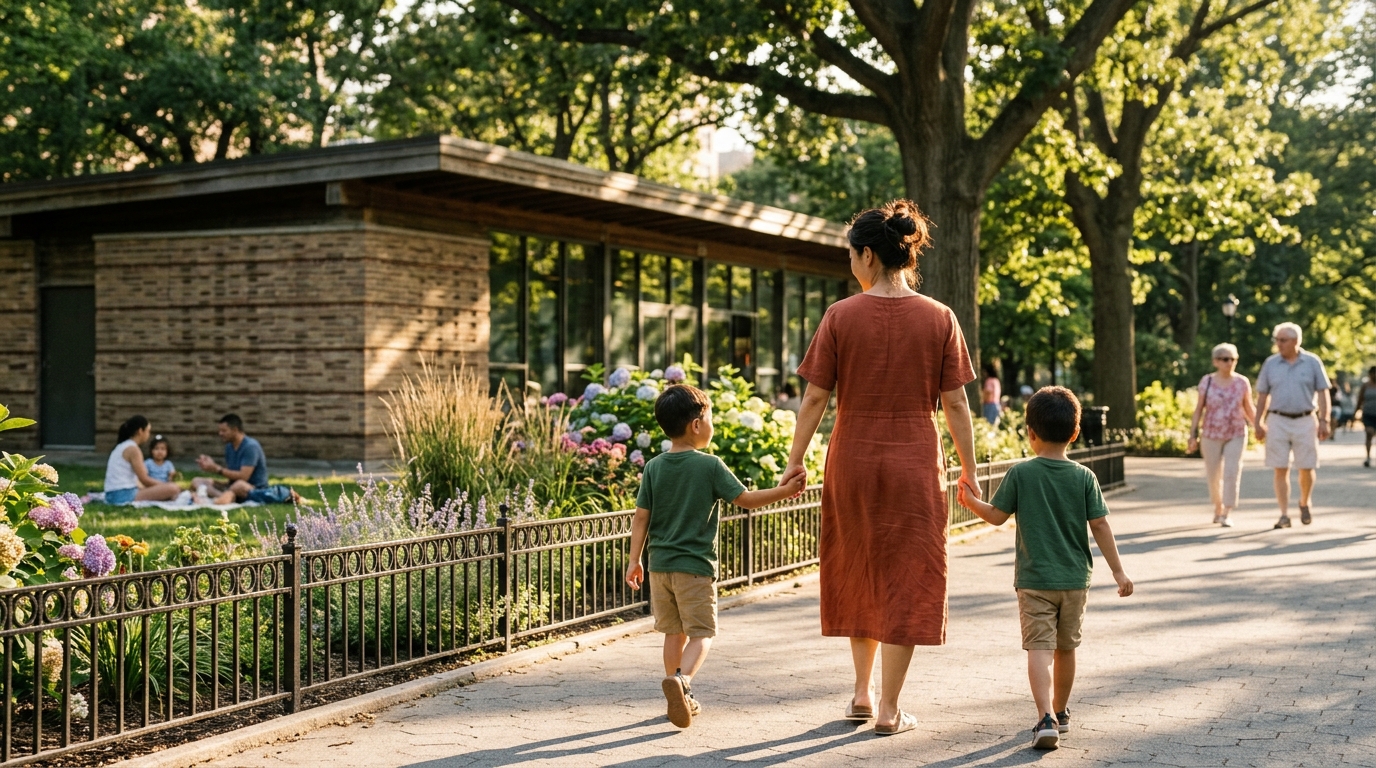
When we hunt for a new home, we often fixate on the interior footprint: the layout of the kitchen, the sunlight in the primary bedroom, or the storage capacity of the mudroom. We treat the house as a self-contained vessel for our domestic lives. However, for parents, the most important square footage is actually located outside the property line. The true value of a neighborhood is not found in a real estate listing but in the silent education children receive simply by moving through their local streets.
Consider the daily walk to the local library or the community garden. These are not merely logistical trips. They are lessons in civic participation. When a child sees a neighbor tending to a public flower box or observes the local librarian greeting regulars by name, they are learning about stewardship and social fabric. A walkable neighborhood is a sensory curriculum that teaches children how to navigate the world with confidence and curiosity. Before they are old enough to cross the street alone, they are absorbing the rhythms of their environment: the way the light hits the cafe awning, the bustle of the weekend market, and the friendly nod of the shopkeeper.
Many families prioritize proximity to top-rated school zones, yet they overlook the educational potential of the surrounding geography. A home located near a vibrant public square or a heavily trafficked pedestrian path offers a unique kind of social literacy. Children in these areas learn to read the room of a neighborhood. They witness diverse interactions, see how businesses thrive, and understand the importance of common spaces. This is the foundation of community building. If a child grows up feeling like a stakeholder in their own streets, they are far more likely to develop into an engaged and thoughtful adult.
When you evaluate a neighborhood for its educational potential, look beyond the test scores posted on a website. Instead, look for the density of public life. Is there a local park where children of different ages mingle? Are the streets populated by people walking, cycling, or sitting on front stoops? These are the indicators of a healthy, interactive ecosystem. The presence of mixed-use spaces provides a real-world laboratory for young minds. Watching a local artisan work in their studio or seeing a neighborhood association hold a meeting at the library teaches children that work and governance are human activities, not abstract concepts found only in textbooks.
Walkability is a vital component of this experience. When children are confined to the backseat of a car, they miss the connective tissue of the city. They do not learn how to orient themselves, how to judge distance, or how to interact with the people who share their block. Conversely, children who walk to school or to the neighborhood coffee shop develop a sense of autonomy. They learn to identify landmarks and understand the relationship between their home and the broader community. This physical orientation fosters a sense of belonging that is rarely found in isolated suburban developments.
Furthermore, the local library remains the heartbeat of a child-friendly neighborhood. A robust library is not just a place for books, but a center for community programming, quiet study, and human connection. Being within a short walk of such an institution ensures that learning is treated as a lifestyle rather than a chore. The same can be said for the Sunday farmer market. Taking a child to buy apples from a local grower is a lesson in biology, economy, and ethics. They begin to understand the cycle of food production and the importance of supporting their local economy.
Ultimately, the best environment for a child is one that bridges the gap between the private home and the public square. When you choose a home, you are choosing an environment that will shape your child's perspective for years. Seek out a place where the streets feel like an extension of your living room. Look for the parks, the busy corners, and the shared spaces that invite interaction. Your neighborhood is the first teacher your child will ever have. Choose one that encourages them to look outward, to engage with the world, and to find their place within it.