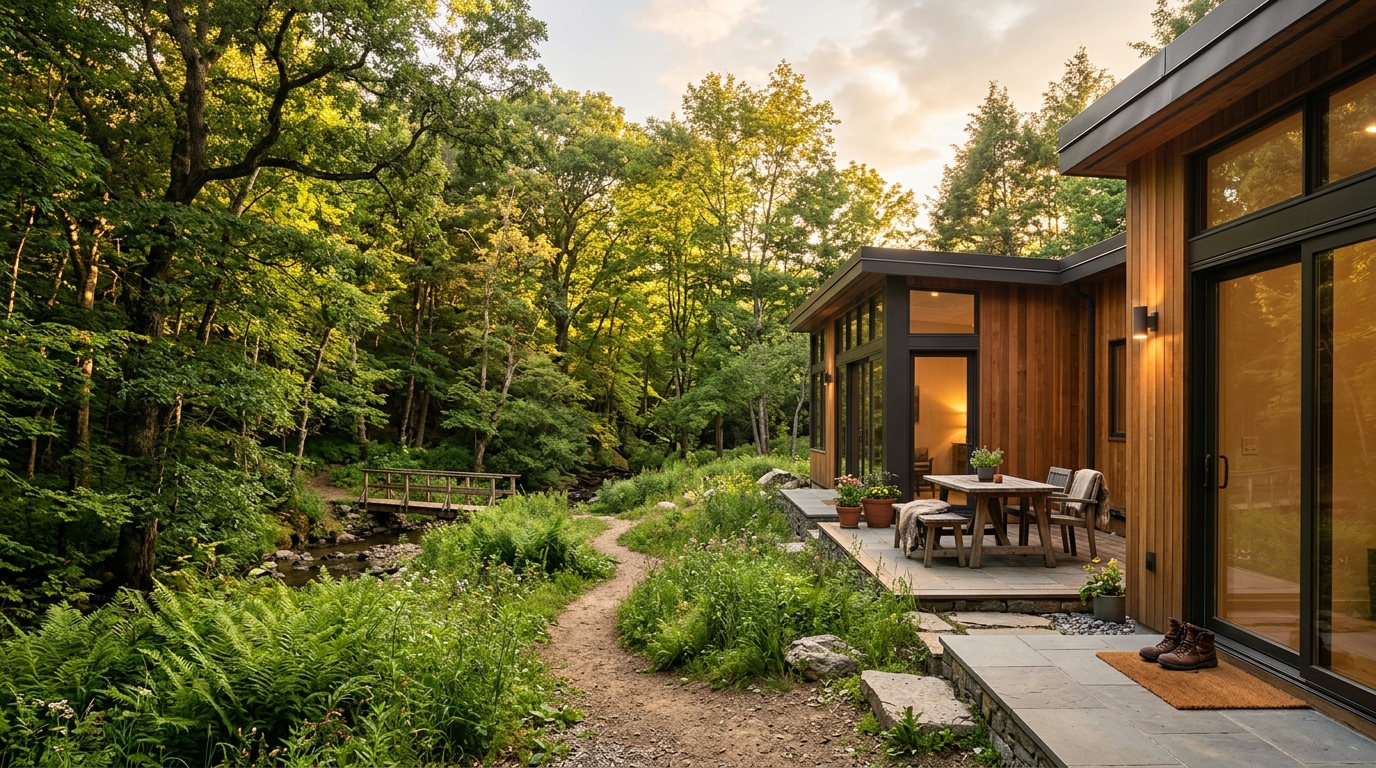
There is a specific kind of silence found at the end of a cul-de-sac where the asphalt simply gives up and the hemlocks take over. In the lexicon of modern real estate, we often prioritize the curated: the perfectly leveled soccer pitch, the pristine playground with its rubberized flooring, and the paved loop where strollers glide without a bump. But for a growing number of residents, the true soul of a neighborhood is found in its unmanicured edges. This is the wild margin, the liminal space where the city’s jurisdiction fades and the unruly, beautiful chaos of the natural world begins. It is the place where the backyard fence does not mark an ending, but a beginning.
When we look for a home, we are often told to look for the view. Yet, there is a profound difference between a view of a manicured park and a view into a thicket. The manicured park is a performance: it is mowed, blown, and edged to meet a civic standard of neatness. The wild margin, by contrast, is a living process. It is the creek that swells with the spring rains, the stand of ancient oaks that drops a heavy carpet of gold in October, and the dense undergrowth that provides a sanctuary for owls and foxes. For the homeowner whose property abuts these spaces, the recreation offered is not about organized sports or scheduled matches. It is about the quiet recreation of observation: the ability to witness the slow, rhythmic pulse of the seasons from a kitchen window.
Living on the edge of a wild space changes the way a family moves through the world. In these neighborhoods, the most prized amenity is often a simple dirt desire path that leads from a back gate into the woods. These are not the official trails marked on a city map: they are the secret corridors forged by decades of neighborhood children and wandering dogs. To live here is to embrace a life of unstructured discovery. It is the Sunday afternoon spent identifying mosses or the morning walk where the only goal is to see if the local heron has returned to the marsh. This form of recreation is restorative in a way that a gym or a tennis court can never be: it requires a different kind of attention, one that rewards patience and curiosity over competition.
There is also a practical, domestic luxury to the wild margin. In an era where privacy is increasingly difficult to find, the messy edge of a park acts as a natural, ever-changing buffer. While a tall cedar fence might provide a visual barrier, it also creates a sense of enclosure. A thicket of wild dogwood and bramble, however, provides a sense of depth. It allows the eye to travel, creating an expansive sense of space that makes a standard quarter-acre lot feel like a vast estate. The wild margin does not just separate you from your neighbors: it connects you to the horizon. It is a psychological release valve that reminds us that we are part of a larger ecosystem, even in the heart of a suburb or a city edge.
For parents, the value of the wild margin is often measured in the resilience of their children. There is a growing movement toward the adventure playground, but the best adventure playground is often just a downed log over a shallow stream. In neighborhoods that embrace these unmanicured zones, children learn to navigate uneven ground, to respect the power of moving water, and to find wonder in the small things, such as a perfectly preserved dragonfly wing or a smooth river stone. This is the education of the senses, a form of play that fosters independence and a lifelong connection to the environment. It is a neighborhood quality that cannot be quantified by a school rating or a walkability score, yet it is arguably one of the most formative influences a home can offer.
When searching for this kind of life, the savvy buyer looks for the shaggy parts of the map. They look for the properties that border conservation easements, protected wetlands, or the steep, unbuildable ravines that the city has left to their own devices. These are the places where the community identity is not forged on the sidelines of a game, but in the shared stewardship of the land. It is the neighbor who alerts the group text to a rare bird sighting, or the informal gathering at the trailhead to clear a fallen branch after a storm. This is community through connection to place, a bond that is rooted in the soil itself. The wild margin is not a lack of maintenance: it is an abundance of life. It offers a way of living that prioritizes the organic over the organized, proving that the most valuable part of a neighborhood is often the part that has been left entirely alone.