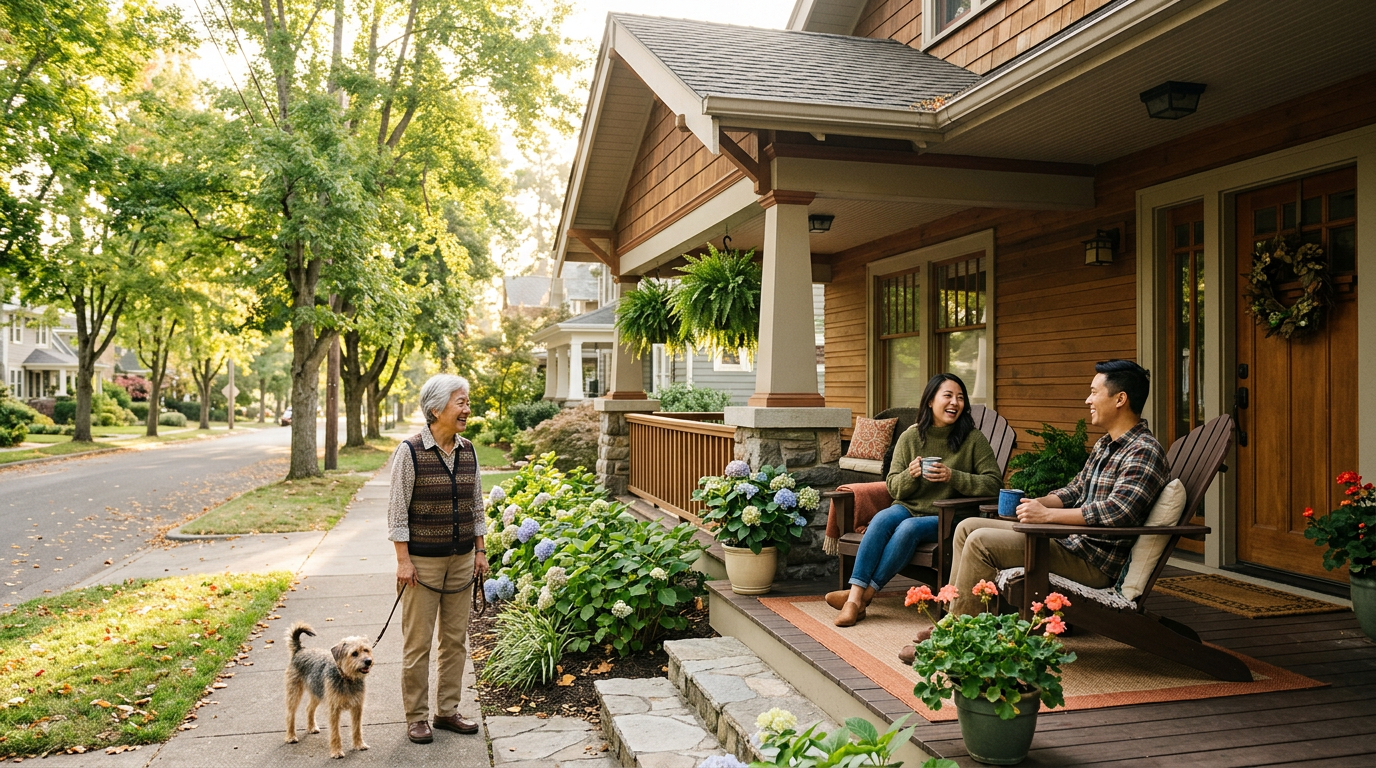
For decades, the American dream was defined by the backyard. It was a private sanctuary, a fenced-off kingdom where the grill was king and the world stayed on the other side of the cedar planks. But a quiet shift is happening in the way we value our living spaces. Today, the most discerning buyers are looking in the opposite direction. They are looking toward the street. The front porch, once a relic of a slower era, has returned as the ultimate luxury for those who realize that a home is only as vibrant as the community that surrounds it.
When we talk about real estate value, we often focus on the internal metrics: the marble in the bathroom, the high-end appliances, the recessed lighting. However, the true quality of a life is often measured by the liminal spaces, those areas where the private world of the family meets the public world of the neighborhood. A house with a deep, welcoming front porch offers more than just curb appeal: it offers a social invitation. It allows for a lifestyle of spontaneous interactions, where a morning coffee is accompanied by the sound of neighbors walking their dogs and a glass of wine at dusk leads to a conversation with the person across the street.
This shift toward front-facing living is rooted in a desire for human connection that modern technology cannot replicate. In neighborhoods where the architecture encourages residents to linger out front, the social fabric is demonstrably tighter. Consider the rhythm of a Saturday morning in a community built around these principles. You might start your day at the local bakery, a short three-block walk away, where the smell of sourdough and fresh espresso acts as a beacon for the neighborhood. On your way back, you do not just disappear into a garage. You sit on your steps or a porch swing. You see the children from the local elementary school, a campus known for its vibrant mural and active garden program, practicing their bike riding on the sidewalk. You wave to the librarian who lives at the end of the block. This is the social capital that turns a street into a home.
From a safety and security perspective, this architectural style serves a dual purpose. There is a concept known as eyes on the street, which suggests that a neighborhood is inherently safer when its residents are visible and engaged. When homes are designed to look outward, the sidewalk becomes a shared space rather than a transit corridor. Parents feel more comfortable letting their children walk to the nearby corner store or the public library because they know the neighborhood is watching. This sense of collective stewardship is a powerful driver of long-term property value. Buyers are increasingly willing to pay a premium for the peace of mind that comes from knowing their neighbors by name.
The walkability of these neighborhoods is another critical factor. A home with a front porch is often located in a district where the car is secondary to the pedestrian. These are areas where the Sunday farmers market is the highlight of the week, a place to buy heirloom tomatoes and local honey while listening to a neighborhood jazz trio. The context of the walk matters: a high walkability score is not just about proximity to a grocery store, but about the beauty of the journey. It is about wide sidewalks, mature canopy trees that provide shade in the summer, and the visual interest of varied gardens. When you live in a place where the architecture encourages you to step outside, your world expands beyond your property lines.
For those currently searching the market, it is worth looking past the staging and the fresh paint. Ask yourself: how does this house interact with its surroundings? Does it turn its back on the street, or does it embrace it? A home that facilitates the architecture of the hello is one that will provide lasting joy. It is the difference between owning a beautiful object and being part of a living, breathing ecosystem. In an era where we can have almost anything delivered to our door, the one thing we still have to go outside to find is a sense of belonging. The front porch is where that journey begins. It is the heart of a home that understands that the best part of living somewhere is the life you build with the people next door.
Ultimately, the move toward front-facing architecture represents a return to a more intentional way of living. It is a rejection of the isolation that can come with modern suburban design and an embrace of the messy, beautiful, and rewarding reality of being a neighbor. When you choose a home with a porch, you are not just buying a piece of real estate: you are buying a seat at the table of your community. You are choosing a life where the most important connections are the ones made over a shared fence or a casual greeting across a flower bed. That, more than any countertop or fixture, is the true definition of a dream home.