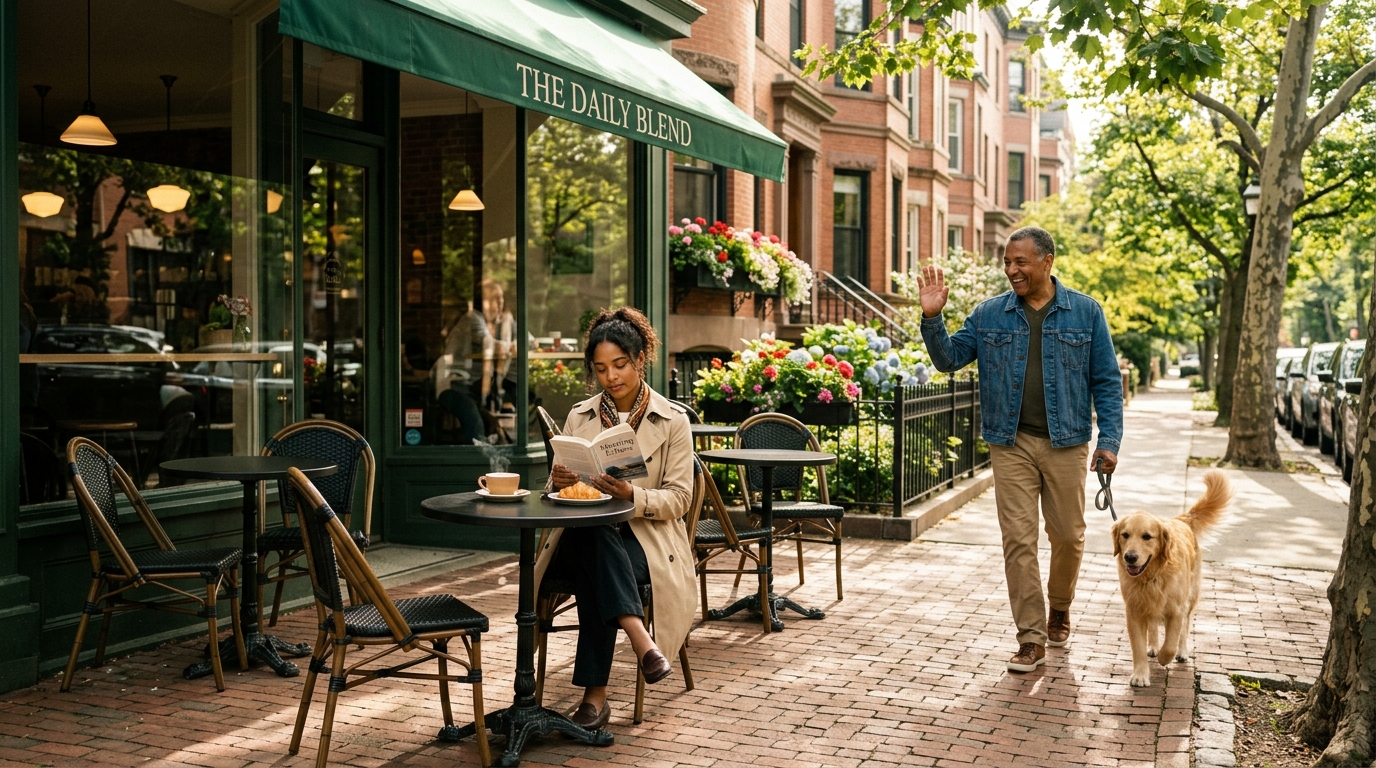
When we talk about the value of a property, we often speak in the language of interiority. We discuss the light in the master bedroom, the depth of the soaking tub, or the way the kitchen island accommodates a holiday spread. But for those seeking a life rather than just a structure, the most important room in the house is often the one that sits fifty yards past the front gate. It is the sidewalk cafe: that curious hybrid of public square and private dining room, where the neighborhood truly reveals its soul.
The morning begins not with the alarm, but with the specific, metallic click of the front door closing behind you. It is a transition from the private sanctuary of the home to the shared theater of the neighborhood. For many prospective buyers, the search for a new address is a search for this specific moment of entry. They are looking for the sidewalk cafe that functions as a social threshold, a place where the community gathers to wake up together. This space acts as a public living room, extending the boundaries of your home far beyond your own four walls.
In a neighborhood where people eat and drink on the sidewalk, the street becomes more than a thoroughfare for cars. It becomes a place of observation and quiet safety. When you see neighbors tucked behind small marble-topped tables, nursing lattes while watching the world go by, you are seeing a community that is invested in its own visibility. This is the concept of eyes on the street, where the presence of diners creates a natural, friendly surveillance. It is the reason why a walk home at dusk feels safer on a block with a humming bistro than on a street lined with blank garage doors. The clinking of silverware and the low murmur of conversation provide a soundtrack of security that no alarm system can replicate.
Consider the choreography of the school run. In neighborhoods anchored by a strong sidewalk dining culture, this daily march is punctuated by brief, meaningful interactions. You see the same faces every Tuesday at the window of the corner bakery. You recognize the local architect who always sketches at the sunniest table, or the elderly couple who shares a single croissant every morning. These small, recurring sightings are the threads that weave a neighborhood together, turning strangers into familiar landmarks of your daily life. You are not just buying a kitchen with high-end appliances: you are buying the right to be a regular in a place that knows how you take your tea.
The quality of a neighborhood is often measured by its walkability score, but a number cannot capture the texture of a truly walkable street. A high score tells you that a shop is nearby, but it does not tell you if the walk there is an experience you will actually enjoy. A street with vibrant outdoor dining offers a human-scale experience. The tables act as a buffer between the pedestrian and the traffic, creating a protected lane where the pace of life naturally slows down. It encourages you to linger, to notice the changing seasons in the flower boxes, and to appreciate the architectural details of the houses you pass. This is the true luxury of a well-placed home: the ability to move through the world at a speed that allows for connection.
For the modern buyer, the midweek take-away window or the sidewalk patio represents a vital third space. It is a location that is neither work nor home, but a neutral ground where the pressures of the day can be left at the curb. When you choose a home based on its proximity to these dining spots, you are choosing a lifestyle that prioritizes the social fabric. You are choosing a neighborhood where the sidewalk is an invitation rather than a barrier. The presence of outdoor seating is a signal that the community values the art of the pause, recognizing that the best parts of a day often happen in the spaces between our obligations.
Ultimately, the perfect property is one that connects you to something larger than yourself. As you walk through an open house, remember to look out the windows. If you can see a cluster of bistro chairs on the corner, you aren't just looking at a restaurant. You are looking at your future front porch, your community bulletin board, and your morning sanctuary. You are looking at a place where you will finally feel at home.