The First Walk Is the One That Counts
Before the inspection report, before the comps, before any conversation about price — there is the walk. Not the walk you take with your agent on a Sunday open house, when everything is staged and the neighbors have conveniently disappeared. The walk you take on a Tuesday at 4pm, or a Saturday morning at 7am, when a place reveals itself in its ordinary rhythms.
Blocks talk. You just have to know how to listen.
What the Sidewalks Say
A well-maintained sidewalk tells you something about civic investment — and about pride. Cracked concrete with no repair patches suggests either an overwhelmed city infrastructure budget or residents who don't engage with local government. Neither is necessarily disqualifying, but both are worth knowing.
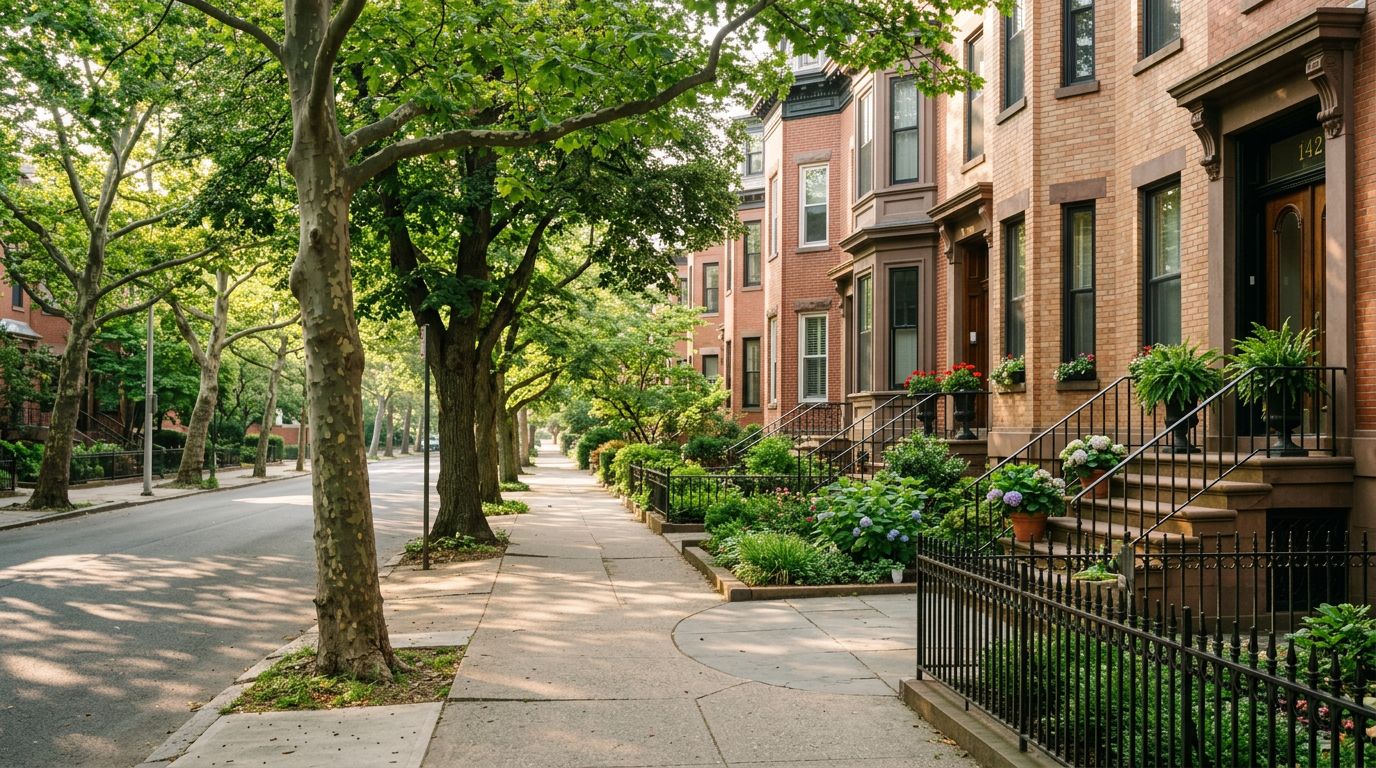
More telling: look at the strip of grass or dirt between the sidewalk and the street. Mature street trees take decades to grow. They signal that people have lived here and stayed, that the neighborhood has continuity. Neighborhoods with no trees feel hotter in summer (they are — measurably) and often feel more transient.
The Stoop Test
In denser urban neighborhoods, stoops are the neighborhood's social infrastructure. Are people on them? Are there plants, chairs, decorations — signs that the stoop is inhabited and cared for? A street of bare concrete steps with nothing personal on them might indicate a high renter-turnover area, where nobody plants because they're not sure they'll be there for the spring.
None of this is definitive. But it builds a picture.
Cars: Parked and Moving
Parking pressure is a real quality-of-life issue that open house listings never mention. Walk the block at 8pm on a weeknight. If every spot is filled and cars are double-parked, you'll be circling for twenty minutes every time you come home from the grocery store. In some neighborhoods this is the price of admission. In others, a block away, it's wide open.
Also: how fast do cars move through? A residential street where drivers treat the speed limit as a suggestion is a different proposition from one with consistent traffic calming measures and drivers who actually slow down for the crosswalk.
The Coffee Shop Indicator
Urban economists have studied this more formally than it probably deserves, but the presence of an independent coffee shop — particularly one that's been open for more than two years — is a signal worth taking seriously. It means: there's enough foot traffic to sustain it, enough disposable income in the neighborhood to support it, and enough community identity that locals chose it over a chain.
One coffee shop is interesting. Three is a movement. Zero means you're either in a car-dependent area or one that hasn't tipped yet — which could be opportunity or could be a long wait.
The Neighbor Conversation
This one takes nerve, but it's the most valuable data point you can gather. Stand near the building you're considering and wait for a neighbor. Say: I'm looking at this place. How long have you been here? What do you think of the block?
People will tell you things. They'll tell you about the noise, the parking, the neighbor on the third floor who throws parties, the fact that the management company recently changed. They'll also tell you about the block party, the community garden they started, the feeling of safety they've had for twelve years.
Your agent can give you the facts of the deal. Only the neighbors can give you the truth of the place.